
The WorldRiskReport
Every year millions of people worldwide suffer from disasters in the aftermath of extreme natural events. But whether it be earthquakes, storms or floods, the risk of a natural event turning into a disaster only partly depends on the force of the natural event itself. The framework conditions of a society and the structures in place to respond quickly and to provide assistance in the event of emergency are just as significant. The more fragile the infrastructure network, the greater the extent of extreme poverty and inequality and the worse the access to the public health system, the more susceptible a society is to natural events. Extreme natural events cannot be prevented directly, but countries can reduce disaster risk by fighting poverty and hunger, strengthening education and health, and taking preparedness measures. Those who build earthquake-proof buildings, install and use early warning systems and invest in climate and environmental protection, are better prepared against extreme natural events.
The annual editions focus on a main topic and include the WorldRiskIndex. Since 2018 the report is published in cooperation with the Institute for International Law of Peace and Armed Conflict (IFHV) of the Ruhr-University Bochum. The WorldRiskReport should contribute to look at the links between natural events, climate change, development and preparedness at a global level and to draw future-oriented conclusions regarding relief measures, policies and reporting.
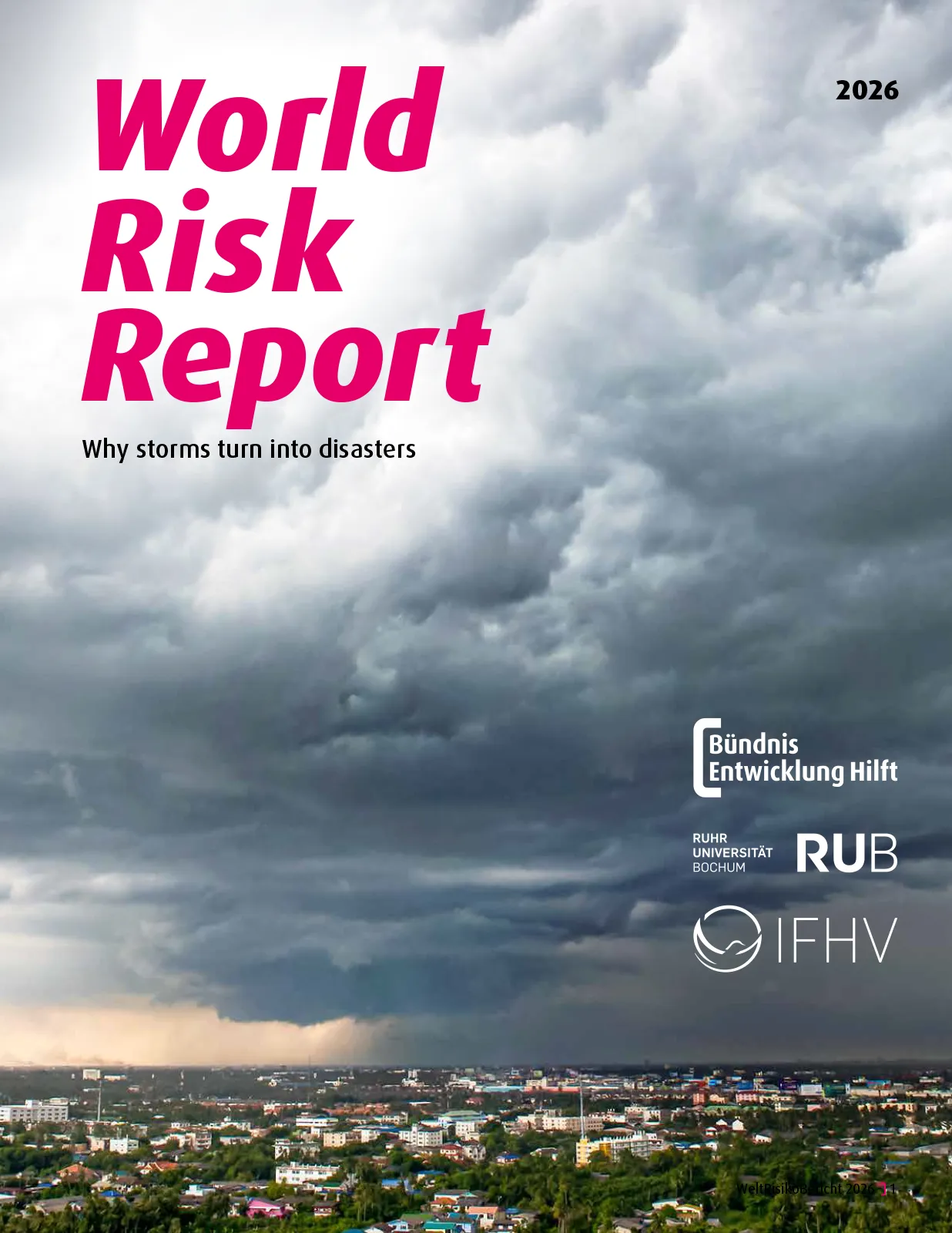
Focus topic: Storms
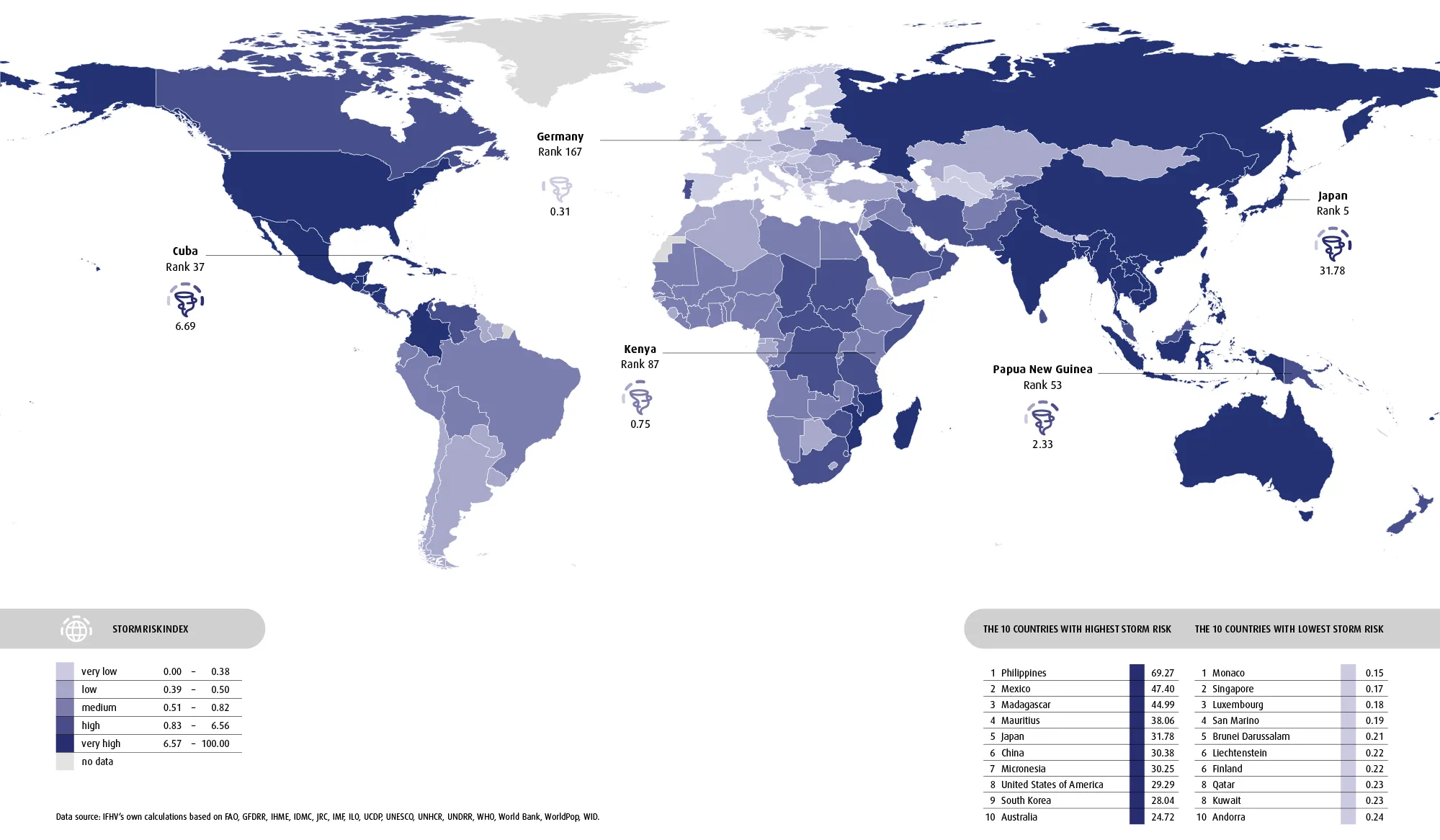
Storms are among the most consequential and most costly natural hazards. In economic terms they cause more damage than any other weather-related extreme event, and after earthquakes and extreme temperatures they claim the most lives. The WorldRiskReport 2026 therefore asks: why does the same storm turn into a disaster in one country while its consequences remain limited elsewhere? The answer rarely lies in the wind alone. Tropical cyclones are not becoming more frequent worldwide, but they are becoming more intense, and increasingly they gain sudden strength just off the coast. This shrinks the window in which people can be warned and seek shelter. It is not the wind that claims the most lives, but the water from storm surges and flooding. Whether a storm becomes a disaster, however, is determined above all by social vulnerability. In poor countries and in rapidly growing coastal cities, the same wind speeds hit more people, weaker buildings, and less protection. Three approaches take center stage:
Early warning systems only save lives if they reach everyone. Too often they are based on wind strength alone and overlook those who do not speak the language, who have difficulty walking, or who have no safe shelter. Effective warning starts with people, not only with the hazard.
Social protection systems are usually tied to poverty, not to vulnerability. As a result, those most in need of protection often go without any safety net. Where the state is absent, informal networks such as neighborly assistance carry people through the crisis, but they quickly reach their limits in major storms. Formal and informal protection are not opposites. They need to complement each other.
Remittances sent by migrants even exceed official emergency aid at a global level. After storms they flow quickly and directly, yet they are largely overlooked in disaster policy. At the same time they reach only households with relatives abroad, which can deepen existing inequalities.
The report’s message is also a call to action. Whether a storm becomes a disaster is not a matter of fate. It is the result of political decisions. Vulnerability can be reduced. Protection is only protection if it excludes no one.
Philippines – Devastation after Super Typhoon Haiyan in Tacloban | © Erik de Castro / Reuters
Worldmap Storm Risk
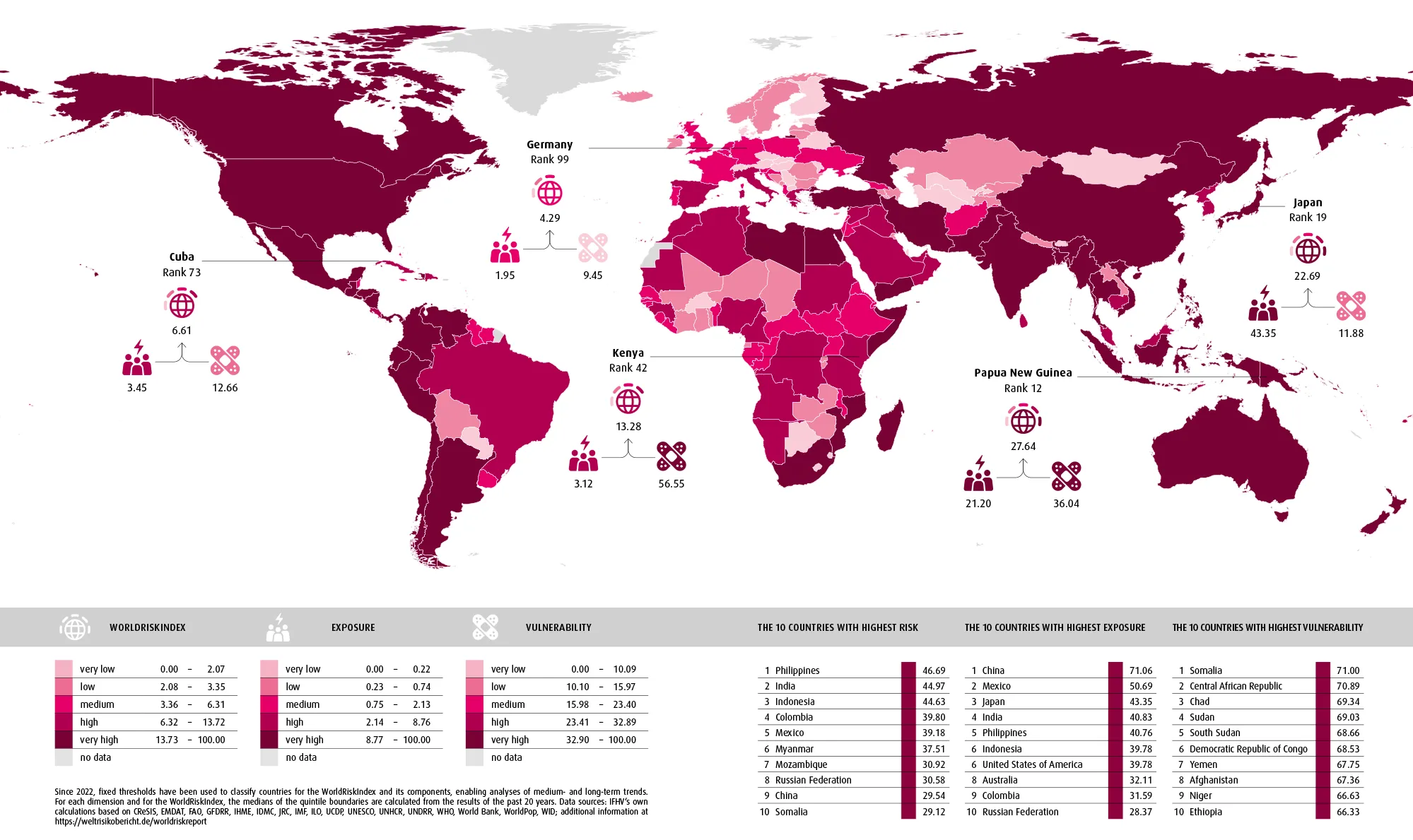
WorldRiskIndex
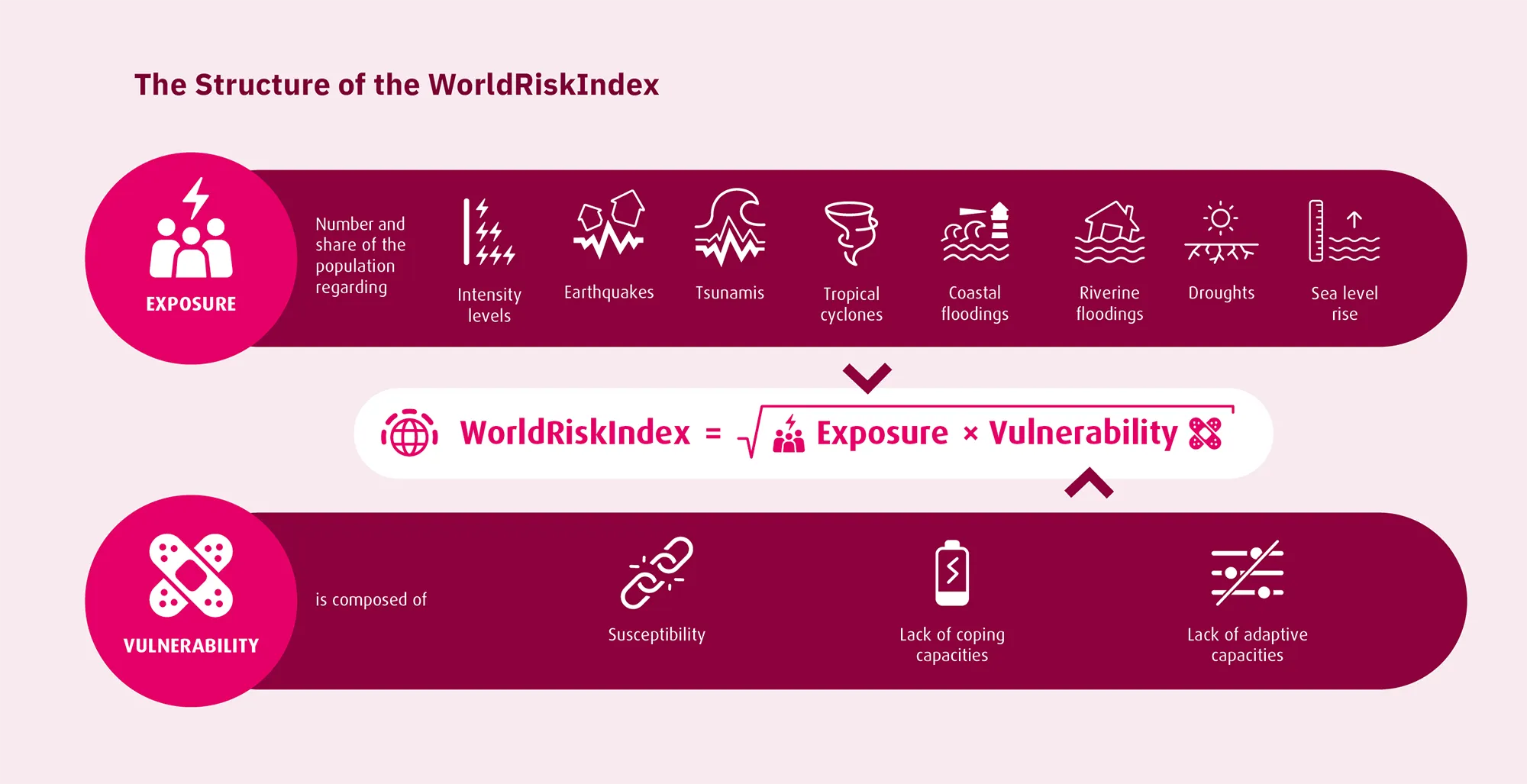
The WorldRiskIndex indicates the disaster risk from extreme natural events and negative climate change impacts for 193 countries in the world. It is calculated per country as the geometric mean of exposure and vulnerability. Exposure represents the extent to which populations are exposed to and burdened by the impacts of earthquakes, tsunamis, coastal and riverine floodings, cyclones, droughts, and sea level rise. Vulnerability maps the societal domain and is composed of three dimensions:
- Susceptibility describes structural characteristics and conditions of a society that increase the overall likelihood that populations will suffer damage from extreme natural events and enter a disaster situation.
- Coping involves various capacities and actions of societies to counter negative impacts of natural hazards and climate change through direct actions and available resources in the form of formal or informal activities, and to minimize damage in the immediate aftermath of an event.
- Adaptation, in contrast to coping capacities, refers to long-term processes and strategies to achieve anticipatory changes in societal structures and systems to counter, mitigate, or purposefully avoid future adverse impacts.
The basic model of the WorldRiskIndex with its modular structure, was developed jointly with the United Nations University Institute for Environment and Human Security (UNU-EHS). Since 2018, the Institute for International Law of Peace and Armed Conflict (IFHV) of Ruhr-University Bochum has taken over the calculation and continuously refined the model conceptually and methodologically. In 2022, the WorldRiskIndex is published with a completely revised model that includes 100 indicators from globally available and publicly accessible databases. For the first time, all 193 member states of the United Nations are represented. Among other things, the WorldRiskIndex serves as a guidance for decision makers and identifies fields of action for disaster risk reduction.
Worldmap of Risk 2026
Calculation of Risk
cyclone-exposure-caribean.xlsx
Wglobal-cyclone-risk-2026.xlsx

Creative Commons Lizenz
The data of the WorldRiskIndex by Bündnis Entwicklung Hilft and Institute of International Law of Peace and Armed Conflict is licensed under a Creative Commons Attribution 4.0 International license (CC BY 4.0).